
Your Strategy. Your Infrastructure. Your Alpha.
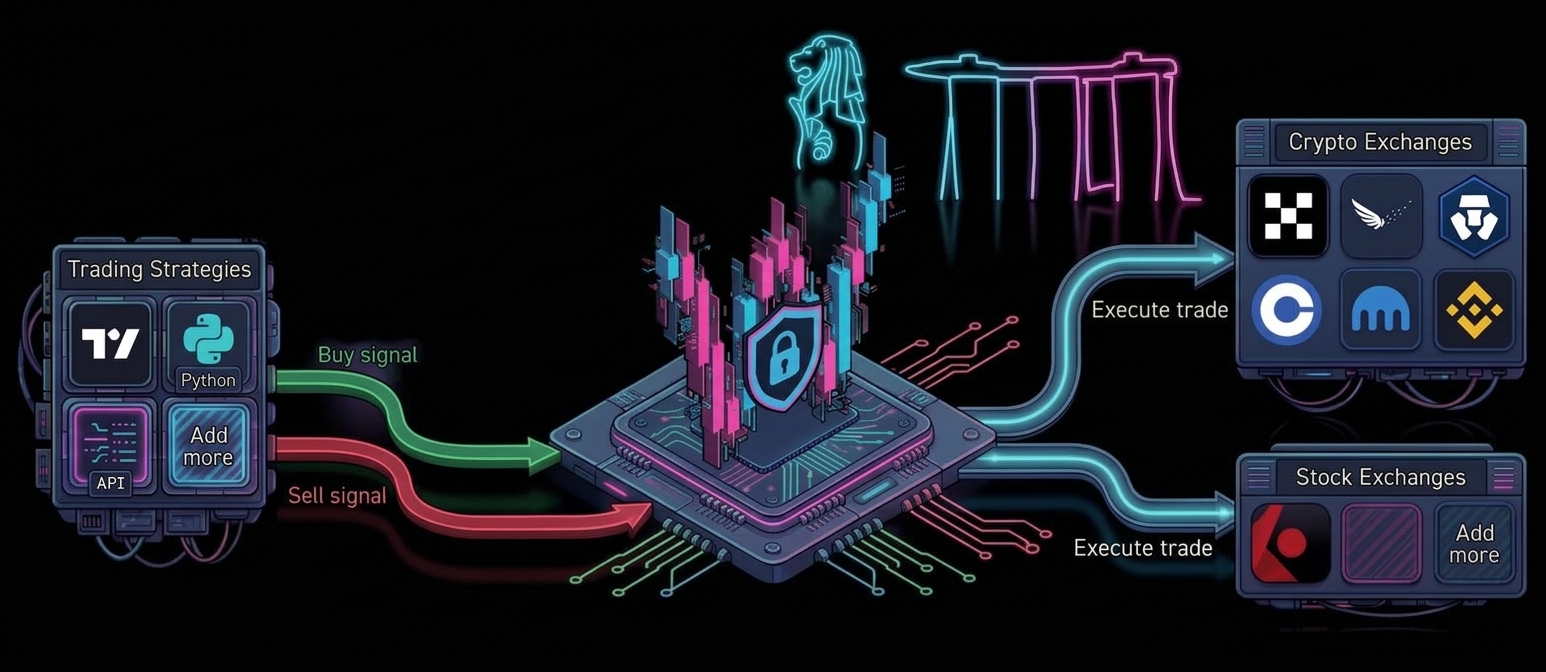
Tradleware is the hardened trading middleware between your custom algorithms and global exchanges. Built for professional traders who demand absolute privacy, local execution, and a zero-trust security architecture. No cloud. No leaks. Just execution.
Key Functionalities
Hardened Logic for Sovereign Traders
Every component is designed to keep your strategy private, your execution fast, and your infrastructure under your control.
Hardened Webhook Gateway
Securely ingest automated signals directly from TradingView or other credible cloud sources into your private local environment.
Sovereign Execution
Move your trading logic off shared servers. Process Every "Buy/Sell" command locally on your own hardware to eliminate platform-side front-running.
Zero-Party Credential Safety
Store your exchange API keys and secrets exclusively on your device. Tradleware ensures you never share credentials with a third-party service.
Multi-Market Bridge
A single, secure point of control for Crypto and Stock execution.
Encrypted Signal Path
From the moment a TradingView webhook hits your IP to the second the order fills, your data is wrapped in end-to-end security protocols.
Regulated Broker Integration
Seamlessly connect to globally licensed brokers like Interactive Brokers, ensuring your automated execution stays within a compliant, regulated ecosystem.
Supported Exchanges & Brokers
Tradleware connects your strategies to globally regulated markets — crypto and stocks, all from your own hardware.






Sovereign Control. Anywhere.
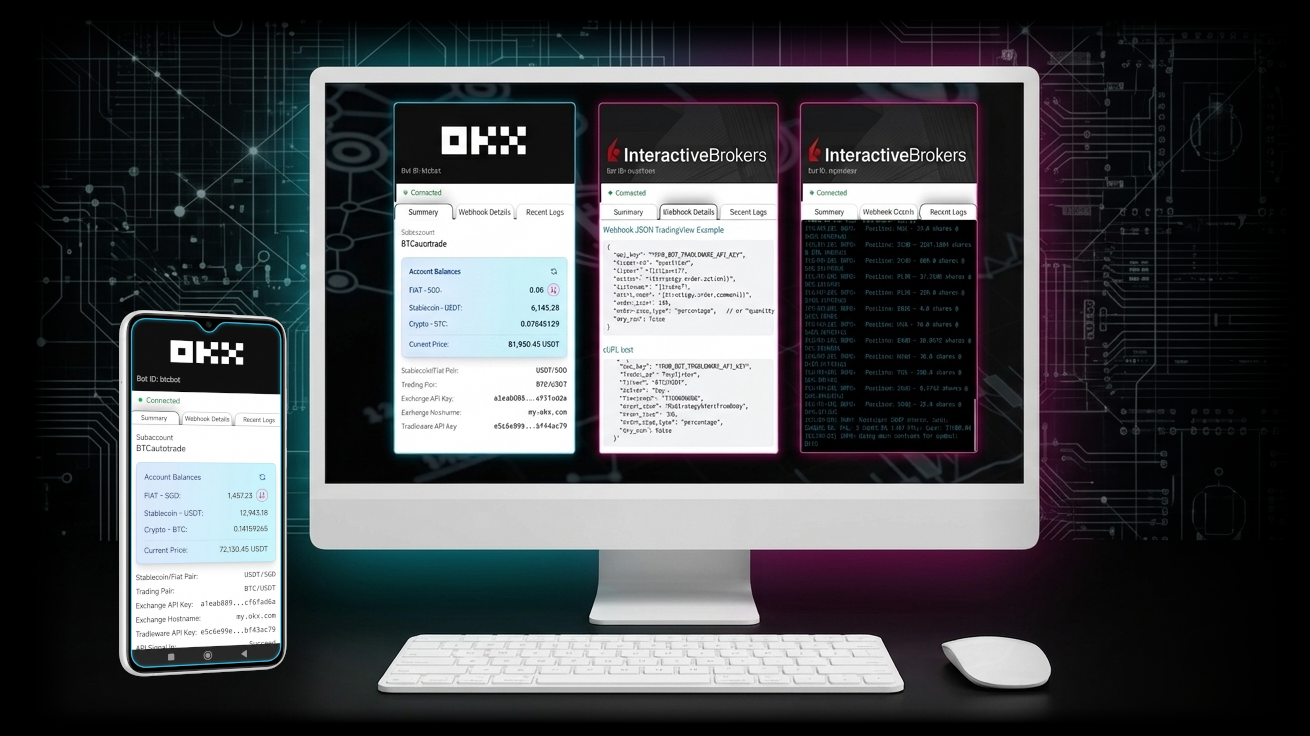
Deploy, manage, and monitor your entire Tradleware fleet across desktop, tablet, and mobile.
Dashboard Features
Fleet Command Center
Unified Dashboard. Instantly view your entire 'fleet' of bots. The card-based system makes multi-account and multi-exchange management visually intuitive and efficient.
Cyber-Color Coding
Visual Clarity. Never confuse your trading assets. Stocks and Crypto bots have distinct cyberpunk highlight colors, ensuring situational awareness across complex asset classes.
Webhook Details & Logs
Sovereign Monitoring. Zero SSH needed. Access a tabbed view to inspect detailed Webhook payloads and live individual bot logs directly in the UI. Total visibility, zero complex setup.
One-Click Conversion
Ease of Use. Move your capital with a single click. Instant conversion between fiat and stablecoins (e.g., USD to USDT) eliminates multi-step exchange processes.
Instant Synchronization
Quick Reconnect/Refresh. Stay current in a fast-moving market. A single button allows you to instantly force a status refresh or reconnect a bot, ensuring your dashboard and execution are perfectly in sync.
The Local Sovereignty Advantage
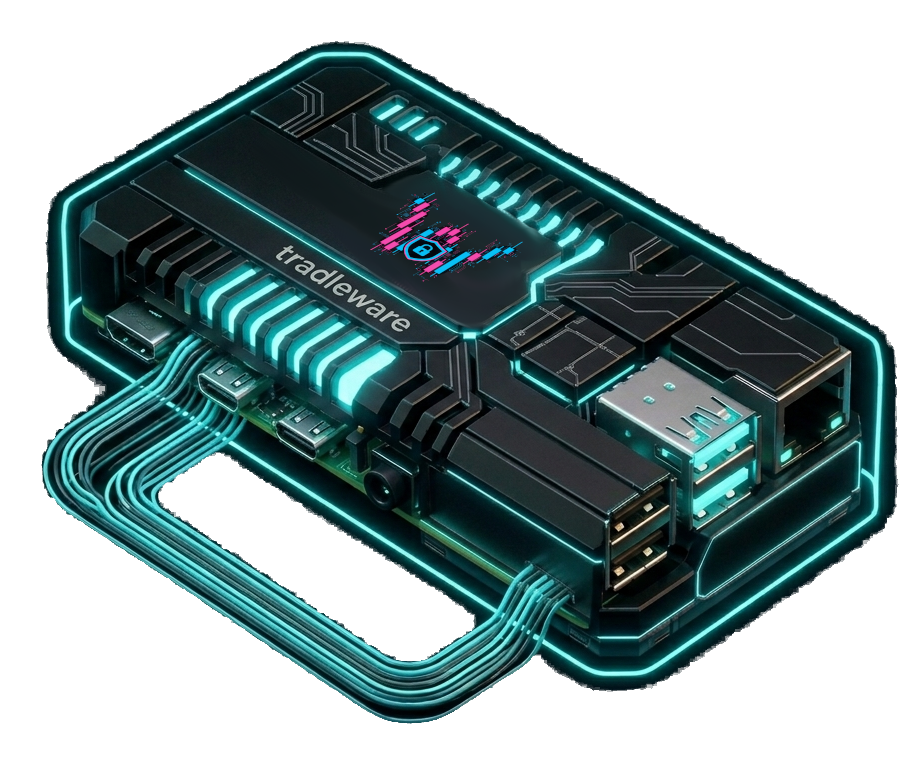
Hardware Independence. All features and management are integrated directly with your local hardware deployment. Run 100% locally on your Raspberry Pi while controlling everything with a slick, remote interface.
The Input
Connect Your Favorite Signal Sources.
Stop being locked into proprietary platforms. Whether you are using TradingView alerts, custom Python scripts, or third-party APIs — just fire a simple JSON webhook at Tradleware and your logic is instantly captured and prepared for safe, local processing.
Percentage, Quantity or Cash
Set order_size_type to "percentage" to deploy a dynamic slice of your live balance, "quantity" for exact lot sizes, or "cash" to invest a fixed amount — the way recurring DCA actually works. The same field works on every broker: stocks size against your account currency, crypto against the pair's quote currency.
Safe Dry-Run Mode
Set dry_run to true to validate end-to-end signal routing without touching your live balance. Remove the flag to go live instantly.
Per-Bot API Key Isolation
Every bot carries its own api_key. If one external script is ever compromised, revoke just that key — the rest of your fleet keeps running unaffected.
The Config
One YAML File Per Bot.
No databases, no GUIs to navigate, no proprietary scripting. Drop your API keys, ticker pair, and a securely generated per-bot Tradleware API key into a plain YAML file and your bot is ready to trade.
Human-Readable Format
YAML is plain text. Read it, audit it, version-control it with Git. No hidden state, no black-box database.
Sub-Account Isolation
Each bot entry maps to one dedicated exchange sub-account — compromising one bot never touches the others.
Multi-Bot in One File
Add as many bots as you need under the same exchange file. Each with its own ticker, API key, and webhook secret.
Stock Trading
IBKR? Same Simplicity.
Interactive Brokers uses a local gateway process instead of a REST API. Tradleware wraps it in a containerized gateway so the config stays just as clean — a few YAML lines and you are executing on regulated stock markets.
Containerized IB Gateway
The cslev/ibkr-docker image runs headlessly on amd64 and arm64 — no desktop, no TWS GUI required. Runs alongside Tradleware on the same Raspberry Pi.
Market-Hours Awareness
Tradleware checks live market hours before placing orders. Set extended_hours: true to allow pre-market and after-hours execution.
Fractional Shares Support
Enable fractional_shares on any symbol that supports it. Tradleware automatically handles the IBKR-specific order flags — no manual workarounds needed.
Sustainable Sovereignty
Performance That Doesn't Cost the Earth.
Ultra-Low Power Consumption
Run your 24/7 trading desk for less than the cost of a single LED light bulb.
Silent & Discreet
No noisy fans or heat exhaust—just silent, sovereign execution tucked away in your home office.
Hardware Longevity
Built to maximize the lifecycle of industrial-grade microcomputers, reducing e-waste compared to traditional desktop setups.
Strategic Autonomy
Your Alpha belongs to You.
Eliminate Conflict of Interest
Trade against the market, not the platform providing your tools.
Pure Proprietary Logic
Deploy unique Python strategies that "off-the-shelf" bots simply cannot replicate.
Zero Signal Leakage
Prevent exchanges from "seeing" your strategy's decision-making process before the order is even placed.
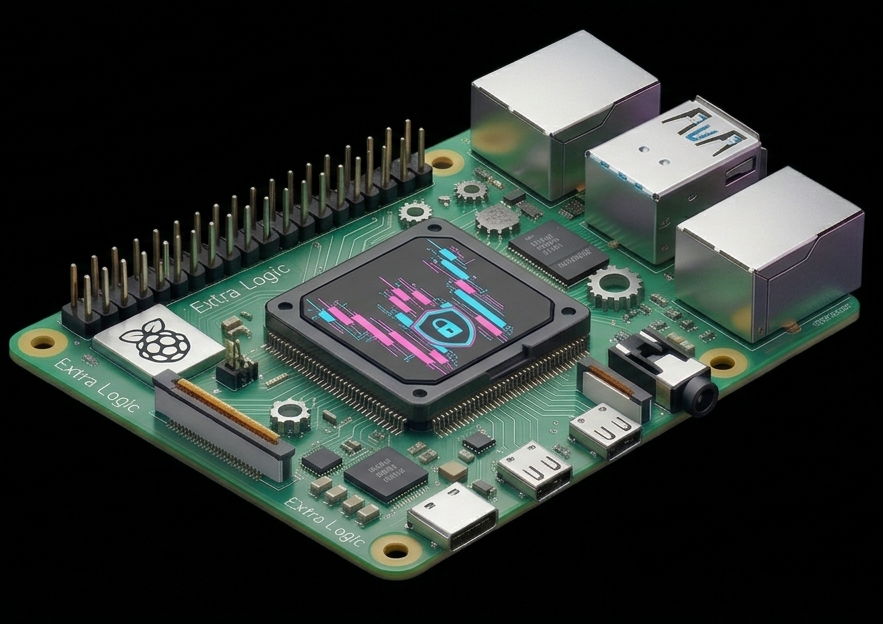
Responsive Control. Open Foundations.
I believe in the power of open-source and modern architecture. Tradleware isn't a "black box" — it's a transparent, extensible platform built on the world's most trusted technologies. Our responsive dashboard allows you to monitor fills and manage signals from your desktop or on the go, without compromising the security of your local execution.
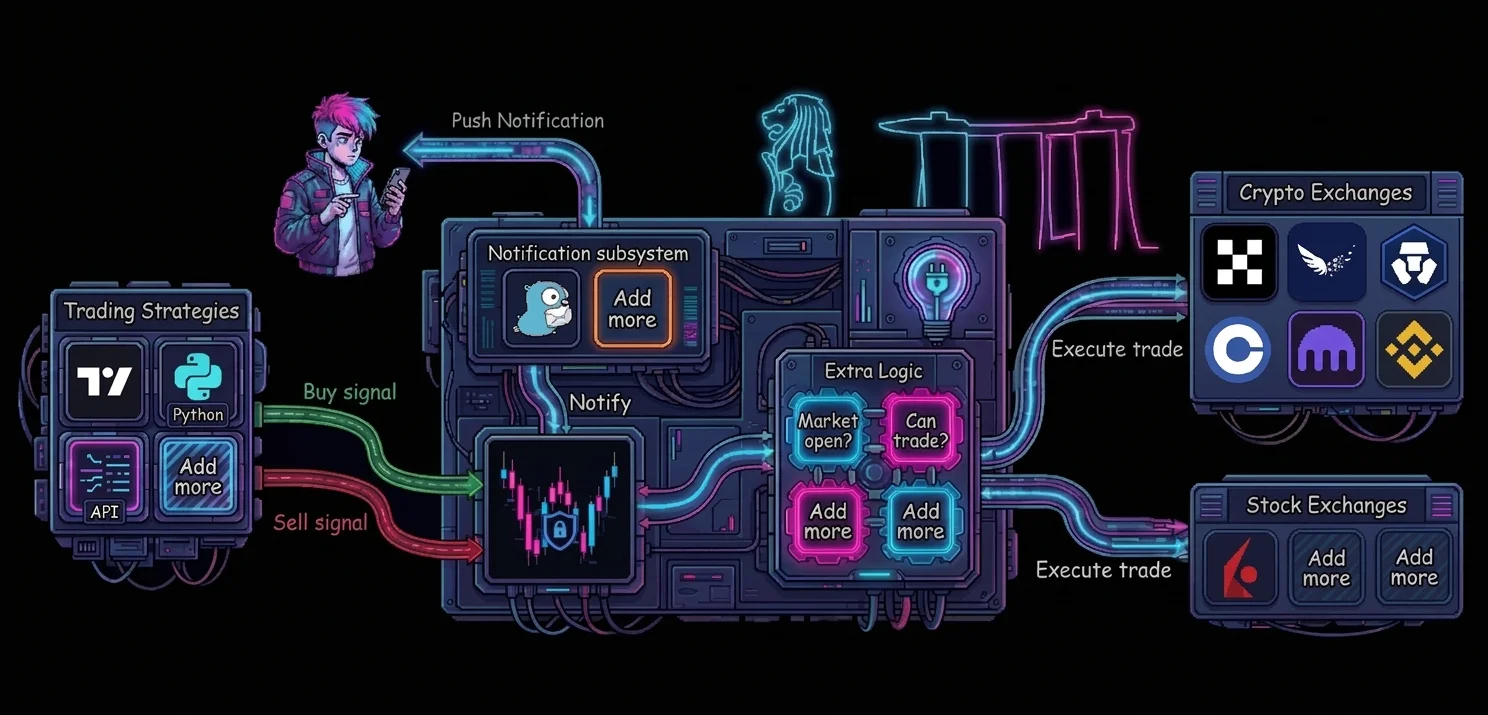
Technical Specifications
Hardened & Convenience Features
Every layer of Tradleware is engineered for security, isolation, and professional-grade control.
Multi-Exchange Core
Native, high-performance connectors for Interactive Brokers, OKX, Coinbase, Independent Reserve, and Crypto.com. One gateway to rule all your accounts.
Gotify Instant Alerts
Get real-time push notifications sent directly to your phone (via Gotify or your preferred notification subsystem) for successful trades or unauthenticated login attempts. Your desk stays in your pocket.
Webhook Randomization
Defeat botnet discovery and automated attacks by utilizing randomized, obfuscated webhook endpoints unique to your instance.
Granular API Key Management
Generate unique Tradleware keys for every individual bot. If one script is compromised, isolate the threat instantly without affecting your entire fleet.
Instant Kill-Switch (Containerized)
Total control. If an anomaly is detected, bring down your entire Docker stack instantly. You aren't at the mercy of a cloud provider's support ticket.
Trusted IP Authentication
Seamless dashboard access for keyboardless home systems. Allow trusted local IPs to bypass friction while maintaining a hardened perimeter.
Replay-Proof Signals
Every signal must be current and is accepted exactly once. A captured webhook can't be re-fired to trigger a second trade — not an hour later, not ever. Duplicate deliveries from your alert provider are absorbed silently instead of doubling your position.
Serialized Trade Execution
Each bot executes one operation at a time. Two signals landing together can never both size an order from the same pre-trade balance — no double-spends, no surprise over-allocation. Different bots keep running in parallel, so nothing slows down.
Credentials That Never Leak
Your API keys appear nowhere they shouldn't: never in log files, never in push notifications, and masked to a handful of characters on the dashboard itself. Tradleware also grades every bot key on startup and flags anything weak, reused, or left at a placeholder.
Choose Your Path
The Anti-SaaS Model
One of these isn't like the other.

The "Corporate Sheep"
Traditional cloud-based middleware. You pay for the interface, but you lose control of the infrastructure.
- Alpha Leak: Your logic runs on their servers — zero proof it isn't front-run.
- Vendor Lock-In: Proprietary format traps your configs. Switching means starting over.
- API Custody Risk: Withdraw-permission keys on a third-party DB — a prime botnet target.
- Throttled Execution: Signals batched during volatility spikes = slippage when it matters most.
- Forced Upgrades: More bots, more exchanges = higher monthly fees. Your growth is their revenue.
- Downtime On Their Schedule: Maintenance windows during ATH rallies — their SLA doesn't care about your PnL.
- Data Sold as a Feature: Your aggregated trade patterns are their product. You're not the customer — you're the inventory.
- Opaque Updates: One silent deploy changes execution behavior overnight. No changelog. No rollback.

Sovereign Tradleware
For the tech-savvy, the paranoid, and the brilliant. You provide the hardware; I provide the enterprise-grade execution bridge.
- Zero Signal Leakage: Webhooks & logic processed locally — no external entity sees your Alpha.
- Total Data Ownership: Keys, logs, and configs stay on your hardware. You are the sole custodian.
- Immutable Costs: No tiers, no paywalls. Only cost is the electricity for a low-power ARM device.
- Hardened Security: Zero-Trust architecture with randomized webhooks and container isolation.
- Zero Platform Dependency: Open source & self-hosted — your infra stays live as long as you have the code.
Trade-offs: DevOps Responsibility — you are your own IT department (internet down = bot down). Hardware Setup — one-time physical setup + basic terminal knowledge required. Social Cost — high risk of becoming obsessed with local-latency optimization.
Rapid Deployment
From zero to sovereign execution
Step 1: Pull the Image
docker pull cslev/tradleware:latest
Grab the latest hardened Tradleware build directly from Docker Hub. Our lightweight ARM-optimized containers are ready to run on Raspberry Pi or any Linux-based environment.
Step 2: Isolate Your Risk
Setup Exchange Sub-accounts. For maximum safety, create dedicated sub-accounts at your exchange. This ensures your Tradleware bot is "sandboxed"—it can only access the specific capital you allocate, preventing overexposure or cross-strategy interference.
Step 3: Configure Your Logic
Edit bot_config yamls
Drop in your API keys, subaccount names, ticker symbols, fiat/crypto currencies in human-readable YAML file. No complex database setup or proprietary scripting languages required.
Step 4: Fire Up the Stack
docker-compose up -d
Launch your private trading gateway. The system initializes the FastAPI backend, the Tailwind-powered dashboard, and the Gotify notification bridge in seconds.
Step 5: Sovereign Success
Enjoy Your Edge. Your desk is live. Monitor your fills via the responsive dashboard and receive instant trade confirmations on your phone. You are now trading on your own terms, on your own hardware.
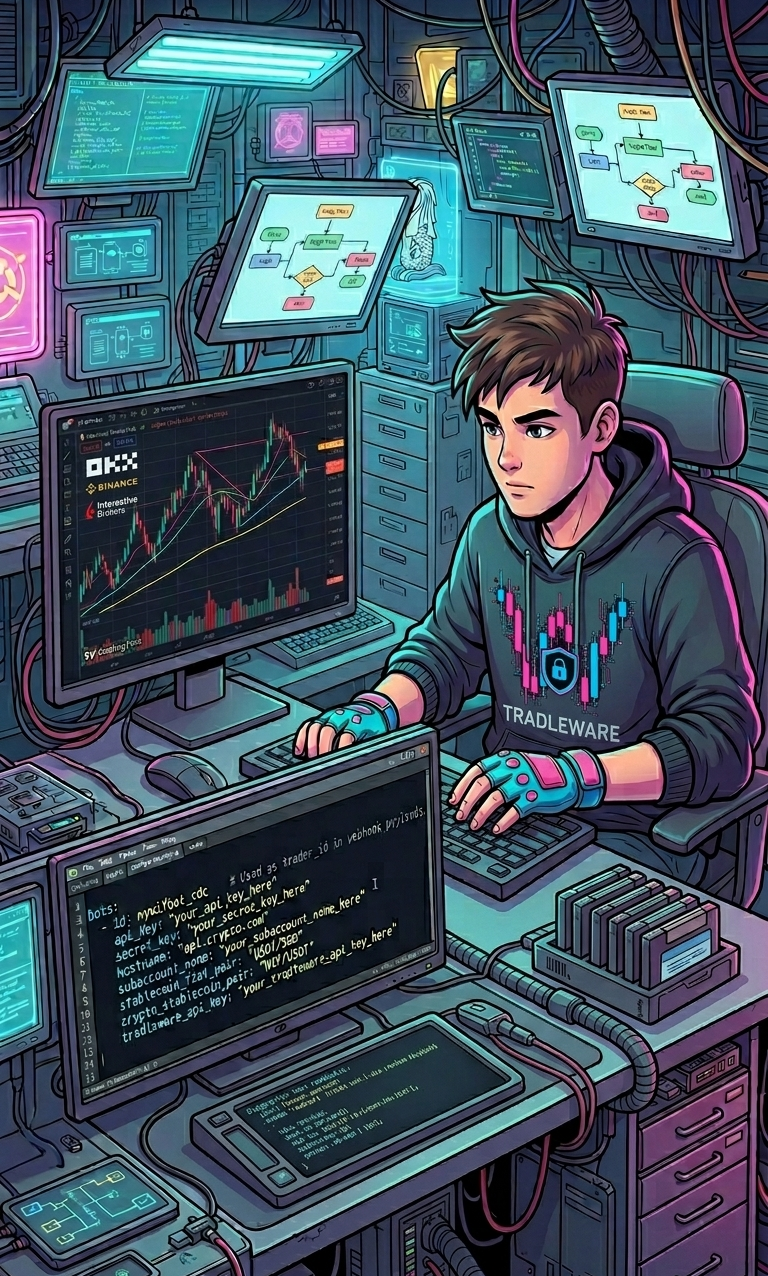
FAQ
Frequently Asked Questions
Everything you need to know about Tradleware — from what it actually is, to why it is free, to how to get started.
Is Tradleware an 'auto-trading bot' that makes me money?
So, does Tradleware generate 'free money'?
Who is Tradleware built for?
Is automated trading legal where I live?
How much does this cost?
Why does the version number end in 'b' (e.g., v3.0.5b)?
Why not just use a cloud-based bot provider?
How does Tradleware compare to SIGNUM (signum.money)?
How does Tradleware compare to 3Commas or Cryptohopper?
How does Tradleware compare to Pionex?
How does Tradleware compare to Freqtrade?
What hardware do I need to run Tradleware?
arm64 or x86_64 device with a stable internet connection and Docker installed is all you need. The typical 24/7 power draw on a Raspberry Pi 5 is under 15W — less than a single LED bulb.Does Tradleware ever see or transmit my API keys?
Which exchanges and brokers does Tradleware support?
Can Tradleware automate stock and ETF trading, not just crypto?
Will Tradleware support more exchanges and brokers in the future?
How does Tradleware connect to stock brokers like IBKR? Is it the same as crypto?
To solve this, Tradleware integrates with IBKR via a purpose-built, containerized IB Gateway (cslev/ibkr-docker), which runs locally on your hardware and handles the broker connection transparently.
One known limitation to be aware of: IBKR's gateway has a built-in auto-logout safety feature that disconnects sessions every 24–48 hours. This is an IBKR security policy, not a Tradleware limitation — it cannot be disabled or overridden. As a result, you may need to reauthenticate periodically (via the gateway's web UI) to keep Tradleware able to execute stock orders. Plan accordingly if you are running 24/7 automated stock strategies.
I found a bug — how can I help?
Ready to Own Your Execution?
Your keys. Your infrastructure. Your alpha.
Deploy Tradleware today — Free forever. GPL v3. PhD-Engineered.